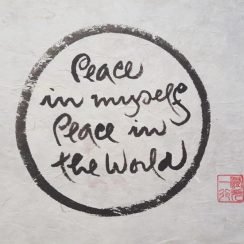
Calligraphy from Zen teacher Thich Nhat Hanh
Three Refuges create a strong support for our lives: Our own true nature, the reality of life, and the community of life.
Three Fundamental Precepts
Do not create harm
Practice good
Actualize good for others
Ten Precept Practices in Daily Life
I vow not to kill but to cherish and love all life.
I vow not to steal but to let go of possessiveness, to live more generously, and to receive what is freely given.
I vow to honor the body and not misuse sexuality, and to be honest and respectful in relationships
I vow to speak truthfully and not to lie, but to see things as they truly are.
I vow not to cloud the mind with substances or other things that create forgetfulness, and to take actions with a clear mind.
I vow not to speak of other’s errors or faults but if needed, to only correct in a helpful and nonharmful way.
I vow not to elevate myself nor to put others down, realizing we are all one.
I vow to give generously, to offer my spiritual gifts freely, to not be stingy or withholding.
I vow not to indulge in anger, and work with it to transform it into healing.
I vow not to speak ill of the Path but to cherish and uphold it.
Guidelines for Daily Life: The Precepts
In Zen practice, we are on a path to bring awareness, benefit to all beings and to our life. The Precepts are ways of harmonious living. Zen is living an awakened life.
These are also called the Bodhisattva precepts because a “bodhisattva” in Sanskrit means “one who practices good.” Not given as rules, these precepts offer guidance and challenge us to live a life of non-harming and unselfishness.
The precepts are written in the form of “vow,” something to aspire to. They serve as a “beacon light” to wake us up before we react in a harmful way. We learn from engaging these precepts and working with ourselves in living a Awakened life.
We offer Precepts study annually.